Last updated on July 18, 2026
Credibility guarantee:
✅ Based on first hand experiences
✅ In-person visit in the field
✅ Official sources included
✅ Realistic accessibility information
This guide is about the student transport ticket in Germany and contains specific information relevant to students going the University of Kiel/Christian Albrecht Universität (CAU) in Kiel in Schleswig-Holstein, but also applies to universities in Lübeck and Flensburg. General information applies throughout Germany. For the full list and area of validity, see this page: https://asta.uni-kiel.de/en/semesterticket/geltungsbereich/.
What is the Semesterticket (now known as the Deutschlandsemesterticket)?
The Semesterticket is a transportation ticket issued to tertiary students in Germany that allows students to use the public transportation system for free. Not all universities have this, but most of them do.
Previously the ticket was called the Semesterticket. Since the last season (2024-2025), it is now known as the Deutschland-Semesterticket.
It is only valid for the ticket holder, and your ticket will have your photo and name on it. Previously it was valid only in the issued area. During the 9€ ticket period in 2022, it allowed you to travel across the entire country on regional and local trains. Now, the student Semesterticket is valid across the entire country on participating public transport services, usually public buses, ferries, trams, and trains. Ferries from Kiel to the island of Sylt, and private services like Flixbus and Flixtrain are not included. For trains, it is only valid in second class and on local and regional trains, ie, not the red and white fast ICE trains. No bookings are required. Read this guide for more information about the train system in Germany.
Who issues the ticket?
The transportation body that governs and issues the ticket will be different for each area. For example, for students in Schleswig-Holstein (Kiel, Lübeck and Flensburg), it is the NAH.SH, Nahverkehr Schleswig-Holstein (Local Transport Schleswig-Holstein), but for students in Hamburg, it’s the HVV, Hamburger Verkehrsverbund (Hamburg Transport Association). It is only issued to participating universities, but most universities have it, and is included in your semester fee.
How do you get a Semesterticket/Deutschlandsemesterticket?
The Deutschlandsemesterticket (previously the Semesterticket) is only issued to participating universities and schools, your school will tell you if they have this, most do.
In order to get the ticket, you have to re-order it every semester. To do this, first, you need to pay your semester fee, which covers the cost of the ticket, to the university. While tuition is free in public universities in Germany, each semester, students still have to pay a few hundred (around 200-300 Euros in Kiel 2022, a price increase is coming for the winter semester, 2026) Euros. This confirms your enrolment by covering administration fees, and the cost of the Semesterticket. You cannot get a Semesterticket without it. You have to upload a photo of yourself which is used as the background of your digital ticket, and add the verification code you receive upon paying your semester fee in the smartphone app as part of the process.
The Semesterticket is actually just a discounted multi-travel ticket for students. Anyone can get a multi-travel ticket, it’s just that the student one is cheaper and allows unlimited travel during your studies. After your application is approved, your ticket will be activated. Your digital ticket can be activated remotely online, all you need to do is download the app onto a smart phone.
How do you use the Deutschlandsemesterticket (previously called the Semesterticket)?
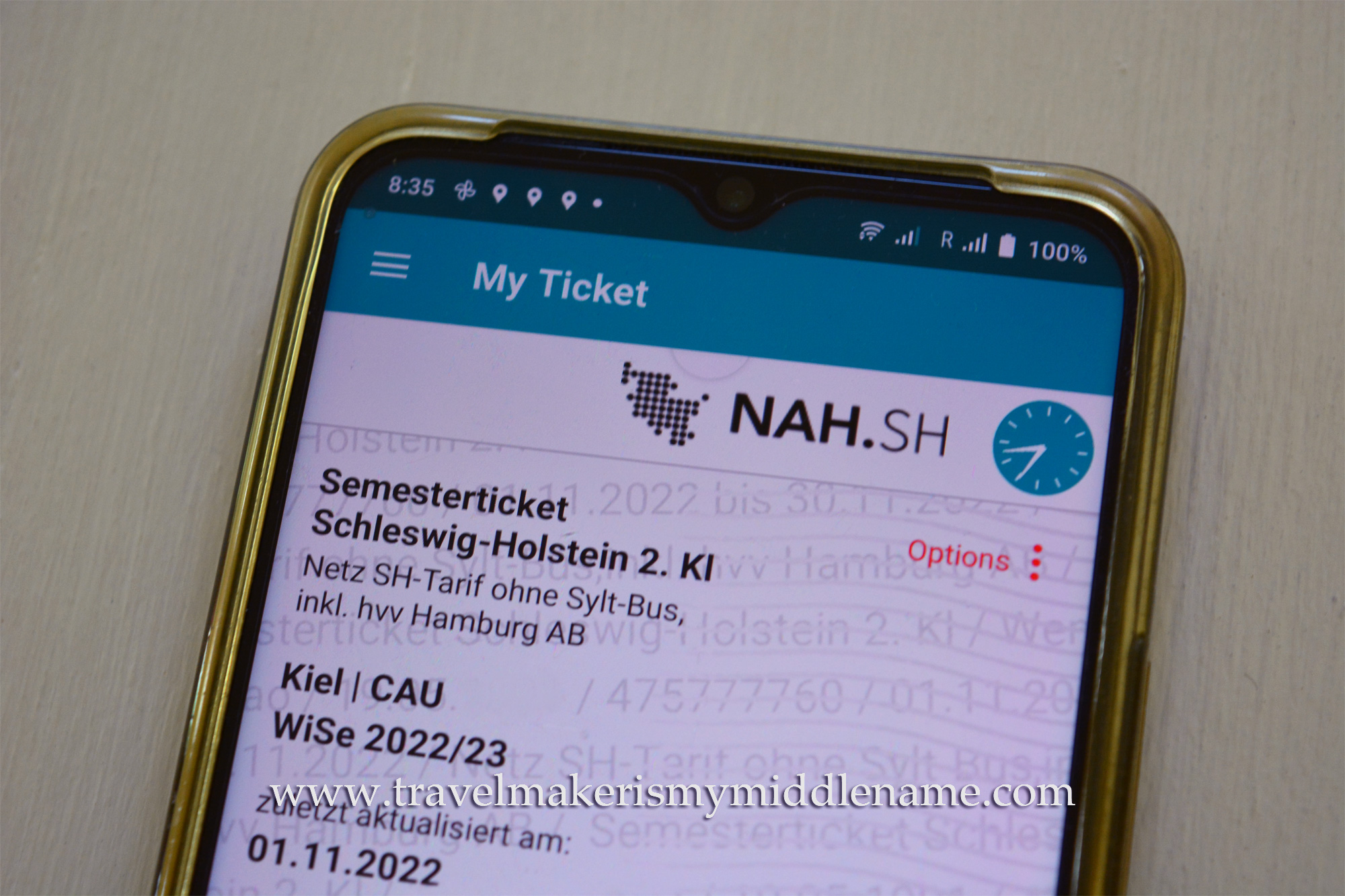
Most students use the digital one by downloading the NSH transportation app on their smartphone and logging in. The app will have your personal ticket on it, plus other transportation functions, namely checking local buses and trains (regional and non-regional) timetables within Schleswig-Holstein. Different states/cities have their own service/website/app, but since the trains run nationally, the trains timetables can be seen in all of them. You can also buy your tickets in the apps.
If you want, you can request a paper one. You will have to carry this ticket with you whenever you use public transport.
The actual semester ticket is the page in the app with your photo and date on it. To use the actual tickets: on a bus, simply show the driver the ticket page in your app as you board, or the paper ticket if you use that. On a train, do the same when a ticket inspector comes to check the tickets.
Ticket areas of validity
The area of validity and services of validity can vary, for students going to Kiel, Lübeck, or Flensburg, check out the details here: https://asta.uni-kiel.de/en/semesterticket/geltungsbereich/. Generally, it is valid across the entire country (previously it was only valid in the state it was issued), but there are some services that it is not valid on.
There is a detailed set of rules that tells you about the areas of validity, you can check this on the NSH website. But in general: For students at the university of Kiel, Flensburg, and Lübeck, can travel for free within Kiel, Flensburg, Schleswig-Holstein (including to Lübeck and to Sylt), to Hamburg, to Hamburg airport, and within Hamburg, on buses, local trains (RE (regional) and RB bahns), underground metros (U-bahn), overland trains (S-Bahns), are all free. Within Kiel, you can also use the local ferries for free too (note: this does not include the overnight commercial cruises to other countries, such as Sweden or Norway that departs from Kiel).
Important Note!
The Semesterticket is not valid on long distance and private and commercial transport providers like ICE trains, Flixbus, and the airport Kielius buses, which travels between Hamburg airport and Kiel. If you are a student and coming to Kiel for the first time and already activated your digital Semesterticket, you can use public transport to get to Kiel from Hamburg Airport for free.
If you found this article helpful, please make a donation.
I know these messages are annoying, but please don’t skip this. If you’ve read this far, please make a donation. I am not just another blogger soliciting donations.
What I am asking donations for:
I need financial stability because my disabilities and chronic illnesses prevents me from getting a job to recover from a devastating financial loss. I am asking for donations to recover the money I lost.
Why I am asking:
I:
• have serious lifelong disabilities and chronic disease from multiple cancers, including a childhood one that destroyed my ability to grow and develop normally,
• live in a difficult situation,
• lost my life savings.
I am raising funds to rebuild the financial security I lost after becoming the victim of a scam. Due to severe disabilities and chronic illnesses caused by childhood cancer treatment and subsequent health problems, I am unable to work and cannot recover these losses through employment. Donations will help me cover essential living costs, medical expenses, legal costs, and to restore some semblance of living to my life and hopefully, pursue some dreams of mine.
Why now:
People rush to donate when a visible tragedy happens. The rest is ignored. Although my first cancer happened over 30 years ago when I was a small child, the consequences of the treatment is just as devastating, and even more so, since I was robbed of ever having a normal life from the beginning. My consequences are permanent and life-long. While it might not seem like a sudden event with great impact, the reality is, it is indeed an event with severe impacts. I live with the consequences of something I had no say in, every day, and it affects me minute to minute, in an increasingly severe manner, and I will always suffer the consequences, permanently. After years of trying to build financial independence despite my disabilities, I lost my savings through a scam out of desperation to try and leave an unsafe living situation. Because I cannot rely on paid employment, rebuilding those savings is not something I can possibly do alone.
How your donation can help:
The passage of time doesn’t make it better, in fact, it makes it worse. The long term effects of my cancer treatment gave me multiple permanent and degenerative disabilities and chronic medical conditions that requires ongoing health care and support. I have been long term unemployed as a result, and live in an unsupportive household with no other options. To make matters worse, out of desperation to get out of the hole I am in, I fell victim to a scam, losing my entire life savings and leaving me in complete ruin and further unable to change my situation. I am stuck in a vicious cycle because I cannot seek a better environment to move to without money, and I can’t earn money with all my health problems, and I can’t seek treatment interstate or overseas without money.
An authentic request:
I am remaining anonymous for safety reasons, but I have provided verification documents with identifying information redacted, in my fundraiser.
About this site:
Despite my disabilities and chronic health diseases, I love to travel. Most of the travel I have done and places I have visited, I went as a solo traveller. I started this as a blog in 2015, where I posted reviews and practical information about places I have been to. Now, this is a standalone site that contains practical and useful information that I gathered from first hand, personal experience and independent travel, and I pass on this information so you know what you’re doing and what to expect, instead of blindly following a tour group or an influencer’s cherry-picked and staged photos. All the food and destination photos on this website are taken by me. I maintain this site and and my other sites alone, and take great care to ensure content is correct at the time of writing, and practically useful for potential travellers.
If you connect with my story, find my content helpful, and want to support me personally:
Please donate to my personal fundraiser, or share my fundraiser if you cannot. I wouldn’t be asking if I had other options, and if everyone pitched in, my goal can be achieved. You can read about me on my About page. Thank you.
Alternatively, if you would like to support a female, solo and independent traveller, you can have a look at my photos here, prints are available for purchase: https://theintrepidphotographer.com/
©All rights reserved for all content and photographs, usage on 3rd party platforms, including, but not limited to, websites and smartphone apps, and to train AI in any way shape or form, is forbidden without prior written permission. Photos are taken by author unless otherwise stated and is available for licensing.
Related posts:
 Full breakdown of the Masters of Medical Life Sciences at the Christian Albrechts University of Kiel, Germany: Rules, Campus facilities, Semesterticket, Student card and more
 Your practical guide to German Christmas markets: What to see, do, buy, and eat
 Day trips from Hamburg: Lübeck | All seasons + winter itinerary suggestions how to see it on the cheap
 Christmas in Lübeck, Germany: Medieval Christmas market and how to get discounted Christmas chocolate + photos
 Overview of the Masters of Medical Life Sciences at the University of Kiel, Germany – Introduction
 Transportation in Germany | U-Bahn, S-Bahn, Regional and ICE: the different types of trains explained, plus the Straßenbahn