Last updated on July 18, 2026
Credibility guarantee:
✅ Based on first hand experiences
✅ In-person visit in the field
✅ Official sources included
✅ Realistic accessibility information
If you are reading this because you are considering doing the Master’s of Medical Life Sciences at the University of Kiel and want to know what it is like, make sure you check out my introduction to this program in my other article here and my guide on the campus here.
While I enjoyed living in Germany as a student, there were several aspects of the Medical Life Sciences program that was frustrating, not just to me, but to other students too. Find out what they are here so you know what to expect.
Disclaimer: Information here is based on my personal experience and observation. Not everyone may experience the same thing.
General sense of disorganisation
There were some subjects I really enjoyed, and the course content was interesting, informative, and the teachers were knowledgeable and taught well. But this was not true for all subjects. The fact that some subjects were informative and organised and others weren’t, shows that the general administration of this program is disorganised.
Disorganised course content
One of the subjects everyone had trouble with for one reason or another, was Statistics.
What made the statistics module difficult in this course was that the teacher was not very prepared and did not seem very good at teaching. The teacher seemed very confused, unprepared, and either did not know the content that they were supposed to be teaching, or they did not know how to explain it, and the notes we were given weren’t particularly helpful.
I am pretty certain it was not a language issue, because the teacher said they lived in an English speaking country for some time, and there was no language problem with any of the teachers (the entire course was taught in English). I remember specifically, after the first lesson, all the students were very worried/upset/annoyed because it seemed like we were not going to be able to learn anything from the teacher and that we would have to teach the content to ourselves.
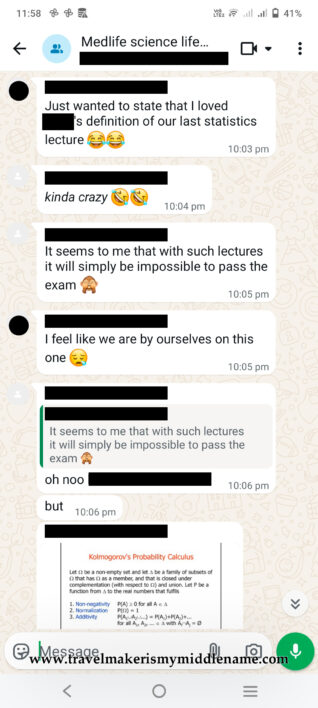

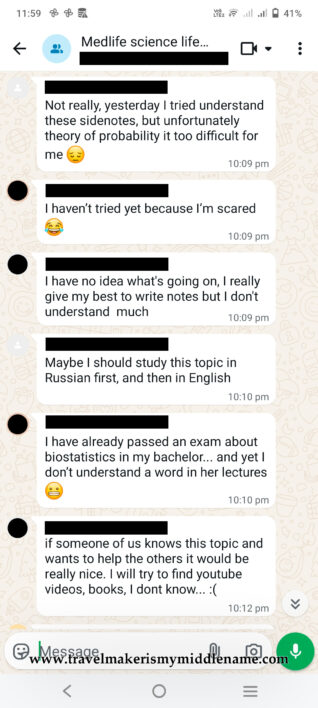
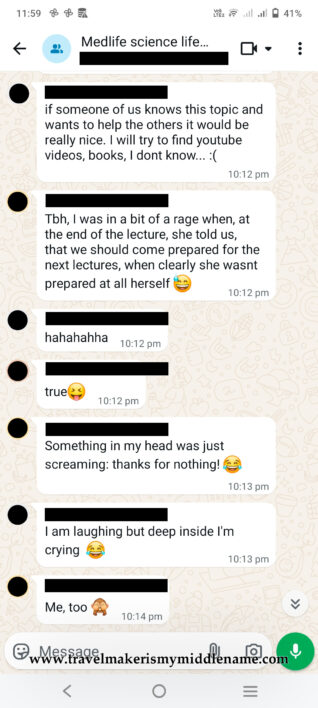
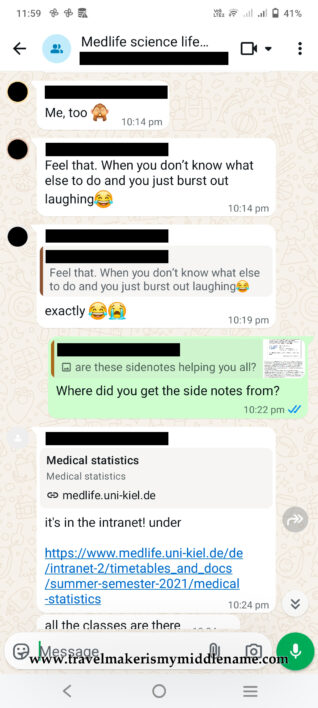
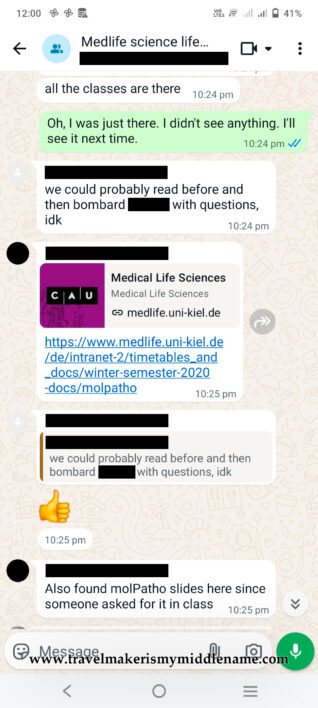
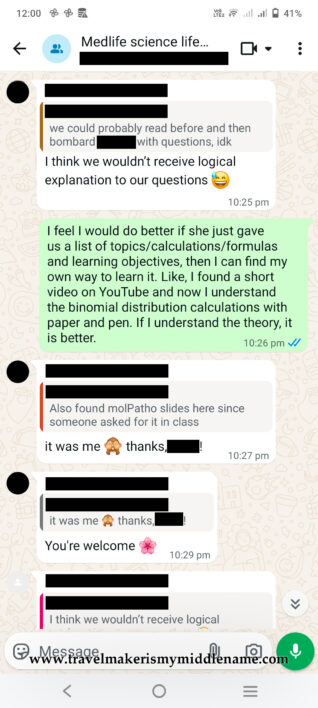
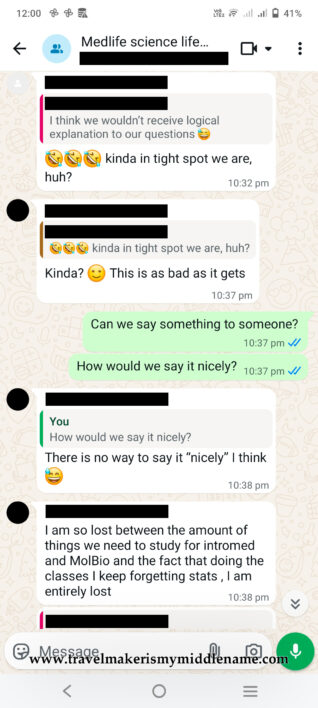
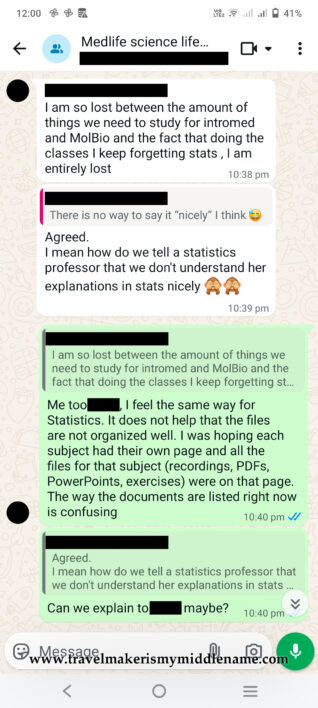
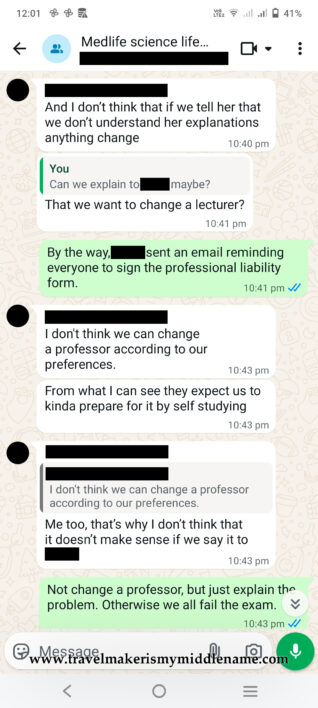
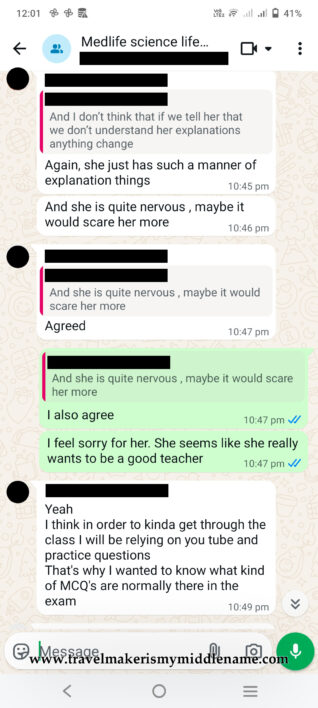
One student was even annoyed that the teacher told us to come prepared next time, because the teacher themselves seemed unprepared. We had to come up with our own way of passing it – some students said they will have to look it all up in their native language. We ended up spending tutorial classes, where we were supposed to do calculation exercises, asking questions and essentially repeating what was supposed to be taught to us in the lectures, to the PhD student who led the tutorial class,. The PhD student seemed to know more about the topic and can actually explain things better than the teacher. I certainly had to do a lot of self-learning with resources outside of the class. I personally relied on tutorials on Youtube and other free online resources, and material from my bachelor’s.
Lack of study resources
While Statistics had past papers and exercise questions for us to revise with for our exams, not all subjects had past papers or exercises for us to revise with. In fact, it was the only subject that had it. This was not good, since the exam questions for one of the subjects were written in a wordy and theoretical way, rather than direct way that tested our knowledge.
This was a particular problem with MolBio because at a master’s level for a program that is not practical or hands on, the exam was unexpectedly theoretical, possibly suited to people with hands on experience at a PhD level, and wordy. My guess is that this exam was written in German and translated to English.
For one of the subjects, students resorted to getting creative and helping each other by sharing the past exam questions they managed to get access to. This is where joining the students Whatsapp group is important.
This reminded me a little bit of how in Harry Potter and the Order of the Phoenix, Delores Umbridge taught Defense Against the Dark Arts in a purely theoretical way and insisted it was a perfectly fine way to learn and teach.
Staff complaints
There was one particular staff member that almost every student had, let’s say, complaints and trouble with. This made the course all that more irritating, because several rules was determined by this person. Let’s call this person “Mr. and Mrs. Smith”. This staff member apparently had no trouble directly criticising the students, even to the point of making a student cry.
All the other teachers were perfectly pleasant and friendly to be around.
Unnecessary grading:
There was one aspect of the course that I and many others didn’t like and felt was completely unnecessary. One of the modules had us prepare and run a mini presentation/conference where we each make a presentation on a topic, and also invite outsider guest lecturers to speak and ask questions.
This was a great idea in theory – scientists regularly attend conferences and network to find out what other scientists are doing.
These additional tasks included making a map and flyer (my job) to be sent to all guest lecturers to show them where the campus was, how to get there from the train station and bus stop, parking information and more. The flyer had to be approved and “Mr. and Mrs. Smith” was particular down to information I included and not included (for examples less detail than I originally put on trains and buses and a little more on parking as apparently, no one was coming by train).
The problem was, not only were we graded on our presentation, we were given additional extra curricular non-academic and unrelated tasks and graded on them, to the point that it was no longer fun.
We also had to find our own guest lecturers to invite, write a letter of invitation, and send them. This job was divided among all the students, we all contacted a different person. This caused considerable frustration, because, who would be willing to travel to Kiel even if the trip is reimbursed, just to make a short 45 minute presentation for a small cohort of master’s students – if we were a group of PhD students with a single area of focus, that might have a bigger chance. And indeed this actually happened – we got no replies, and so the pressure was on to ramp up our efforts to find guest lecturers in time for the deadline that “Mr. and Mrs. Smith” set.
“Mr. and Mrs. Smith” also required the letter of invitations to be written in a specific but trivial way.
Some students were also responsible for setting up the room of chairs, tables, morning tea table of cups, coffee, tea, biscuits, napkins etc. They had to notify “Mr. and Mrs. Smith” in advance so the refreshments could be purchased and hot water be prepared for the day.
The issue that some of us, and certainly I had, was the view that these extra things were unnecessary. We are not graphic design or event management students, yet we were under specific instructions to do these tasks. I later learnt that the maps and flyers I made were not even used.
Inflexibility and bureaucratic frustrations
A lot of the rules in the course, and whether you pass or not seemed like it was up to arbitrary rules set by “Mr. and Mrs. Smith”, as already seen above. From an overall point of view, these were small all issues, but annoying nonetheless.
The lessons for this course were mostly not recorded. For other courses, recorded lectures were apparently the norm. I know this because I regularly spoke to students from other courses, and my friend and neighbour, a Nepalese-American, told me his classes were all recorded.
This was disappointing because we started the course online, live, during COVID lockdowns when we had students from around the world attending from their home countries. For some, it was 3am in the morning, not an ideal time to be taking a class. This student asked for the lectures to be recorded. We did record one lecture once, but in order to do so, we had to all sign an agreement to allow our face and voice to be recorded (the class was done via Zoom and Big Blue Button). This is completely understandable, since Germany and Europe in general has strict privacy rules. Everyone happily signed it since it was what we all wanted.
However, this was not repeated.
Occasionally, even after face to face classes started in person on campus, we had lessons over the internet. This was particularly true for MolPatho, since the lecturer was also part of a COVID board and had to attend meetings, sometimes at short notice. One Christmas, as classes started to wind down and the teacher said we could come or not since it would be mostly a discussion of whatever we want to talk about or review. This class was particularly strange, because the teacher would say frequently that we didn’t have to come to the lectures but was repeatedly surprised that everyone turned up nonetheless (which demonstrates that we do in fact, want to learn and are interested). Also, some students were preparing to travel or go home for the holidays, a student asked if we could have the last class online remotely, as she would be waiting at an airport during the class time. This would have been ideal actually, for all of us, because they were not the only student who would planned to be away, but there were students who had already been away for at least a few days because they were sick. If I recall correctly, there was a case of a broken leg and COVID, and they were particularly hoping for an online, remote class. But: this very liberal teacher told us that, even though they really want to hold the last class online remotely, because it would benefit even him/her, “Mr. and Mrs. Smith” did not allow an online class.
This to me means that rules about the way the course was implemented, was up to a single person’s decision.
The 14% missed class rule
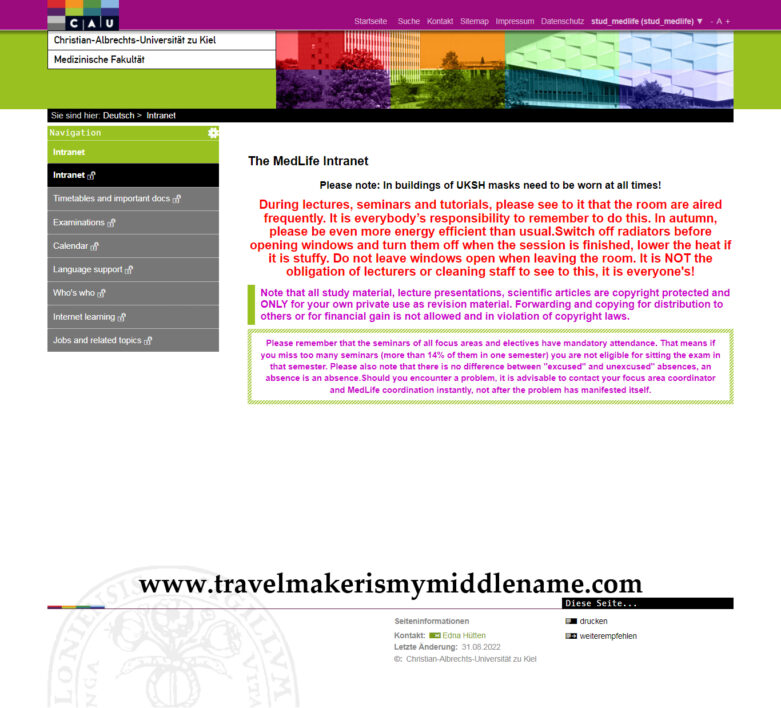
Finally, I was very frustrated by the 14% missed class rule that seemed to only exist in our degree. This rule stated that if you missed 14% of seminars for a module, you are no longer eligible to do the exam for that module that year, meaning even if you do the rest of that module, you can’t pass the subject till the next time you pass that subject’s exam.
The way this rule worked, was, if the percentage of a specific type of classes that you missed is 14% or greater, then you would have violated that rule. The way it is calculated is like this: 14% of the total number of applicable classes for that module is calculated by finding out how many classes 14% is, and rounding up to the nearest whole number. If you miss that amount of classes for that module, you have violated the 14% rule and cannot sit the exam that year and therefore cannot pass the subject that year. If 14% if less than 1, such as 0.87, then you violate the rule by missing just 1 class. If it is more than 1, such as 1.2, it is 2 classes.
To explain further and to put this into perspective: some subjects had several different types of classes, for example, there were lectures, seminars, and tutorials, and not all subjects had exams, some were graded on assignments only. From memory, we only had about 13 weeks of classes per semester. If one subject had one class, one time a week, then one out of ten is already 10%.
We had the different types of classes for a subject, throughout the week. In other words, for example, if we had a 3 classes for statistics a week, it might actually be one lecture, one seminar, and one tutorial, and it may or may not be on the same day.
Obviously no one can choose when to get sick and whether or not TO get sick. However, by the 14% rule, if you happened to miss a seminar class because your were sick, and one seminar class equates to 14% of all seminar classes for the module, then you have violated this rule.
I have several real-life examples of how this affected myself and other people I know, negatively.
About a week before I arrived in Kiel, I managed to sprain or twist my ankle. I was walking down a steep slope that had gravel on it, because there was construction on that path. My whole life I have been plagued with one misfortune after another, and this was no exception. While it was getting slightly better, an event completely undid the recovery.
One day, we had to attend a class in an old anatomical theatre in an old building. The student entry to that room was on the 5th or 6th floor and we had to climb the stairs to the top. I already have a debilitating and degenerative hip condition and disability that makes climbing stairs extremely difficult, and the sprained ankle made climbing the stairs even worse. On top of that, I was already at the right tower and when a friend asked where I was and I said the tower 1. The friend said they were all at tower 2. My group insisted on climbing what turned out to be the wrong tower, so I went there with them. After climbing to the top, we found out it was the wrong one, and we had to go back to the first tower, so I basically climbed 12 flights of stairs with my sprained ankle and the avascular necrosis of both hips and arthritis I got from cancer treatment. By that evening, I could not walk for a week, I could barely get up to walk to the bathroom, and missed several days of class, and of course violated the 14% missed class rule. I didn’t fall behind any of the classes, but only the technical rule stopped me from progressing.
I had a friend who was there before I arrived. This friend got sick during COVID, and the lockdown and isolation gave this friend some mental health problems, and so they also missed several classes, and the same thing happened to them. I met yet another person who had the same thing happen. It was not nice that the faculty displayed no empathy to help those who were sick but instead stuck firmly to the 14% rule. This rule was set for this degree/program only by “Mr. and Mrs. Smith” and no where near a university-wide rule.
This rule is quite unfair. Attendance is less important than you understanding the content of the module. If you can catch up with the subject contents, what difference does it make if you miss a few classes? In my bachelor’s degree, there was a subject that had lectures on at an inconvenient time, so I only went to a few of them, then I studied the content by myself and went to any office hours to ask questions as necessary and I passed the subject without any problems. You can’t plan for and avoid all absences. In fact, the official rules stated that absences due to illnesses are included, and if you anticipate any absences, you were supposed to plan ahead to solve the problem before it arises. This is ridiculous, since no one knows when they will get sick and no one plans to get sick.
Not everyone shares my views. Once I met the 14% rule, I felt there was no more point in me attending the classes for the rest of the semester, since it does not change the outcome. I also had major health issues to deal with, which not everyone understands, sees, or appreciates, which is ironic given the topic they are studying. I had dangerously low haemoglobin which required injections, chronic kidney disease that required me to see a specialist while in Kiel, and unusually extremely swollen legs that made walking more difficult than usual, and given my underweight body mass, I have to use more effort than others to achieve the same outcome and tire out much more easily. During my studies, I had to do some 24 hour urine tests, and monitor my blood pressure at home. I had some students get upset at me for missing the classes and told me that if I wanted to pass the subject, I had to attend the classes.
I learnt from my American friend and neighbour and fellow international student, who studied a different course, that he knew a lot of classmates/friends that took the opportunity to travel or work, since their lectures were recorded. Ours were not, but once I passed the 14% threshold, I decided that I didn’t have to take myself so seriously, I haven’t gotten a meaningful job appropriate to my area of study, or any meaningful job for that matter, since I was legally old enough to work in my home country, and this degree wasn’t going to make a difference, so it was not definitely worth getting more sick over, so I might as well enjoy myself.
And I am glad I did take the time off instead of attending classes that would not have made a difference, because I am no longer able to do the travelling I did at the time.
If you found this article helpful, please make a donation.
I know these messages are annoying, but please don’t skip this. If you’ve read this far, please make a donation. I am not just another blogger soliciting donations.
What I am asking donations for:
I need financial stability because my disabilities and chronic illnesses prevents me from getting a job to recover from a devastating financial loss. I am asking for donations to recover the money I lost.
Why I am asking:
I:
• have serious lifelong disabilities and chronic disease from multiple cancers, including a childhood one that destroyed my ability to grow and develop normally,
• live in a difficult situation,
• lost my life savings.
I am raising funds to rebuild the financial security I lost after becoming the victim of a scam. Due to severe disabilities and chronic illnesses caused by childhood cancer treatment and subsequent health problems, I am unable to work and cannot recover these losses through employment. Donations will help me cover essential living costs, medical expenses, legal costs, and to restore some semblance of living to my life and hopefully, pursue some dreams of mine.
Why now:
People rush to donate when a visible tragedy happens. The rest is ignored. Although my first cancer happened over 30 years ago when I was a small child, the consequences of the treatment is just as devastating, and even more so, since I was robbed of ever having a normal life from the beginning. My consequences are permanent and life-long. While it might not seem like a sudden event with great impact, the reality is, it is indeed an event with severe impacts. I live with the consequences of something I had no say in, every day, and it affects me minute to minute, in an increasingly severe manner, and I will always suffer the consequences, permanently. After years of trying to build financial independence despite my disabilities, I lost my savings through a scam out of desperation to try and leave an unsafe living situation. Because I cannot rely on paid employment, rebuilding those savings is not something I can possibly do alone.
How your donation can help:
The passage of time doesn’t make it better, in fact, it makes it worse. The long term effects of my cancer treatment gave me multiple permanent and degenerative disabilities and chronic medical conditions that requires ongoing health care and support. I have been long term unemployed as a result, and live in an unsupportive household with no other options. To make matters worse, out of desperation to get out of the hole I am in, I fell victim to a scam, losing my entire life savings and leaving me in complete ruin and further unable to change my situation. I am stuck in a vicious cycle because I cannot seek a better environment to move to without money, and I can’t earn money with all my health problems, and I can’t seek treatment interstate or overseas without money.
An authentic request:
I am remaining anonymous for safety reasons, but I have provided verification documents with identifying information redacted, in my fundraiser.
About this site:
Despite my disabilities and chronic health diseases, I love to travel. Most of the travel I have done and places I have visited, I went as a solo traveller. I started this as a blog in 2015, where I posted reviews and practical information about places I have been to. Now, this is a standalone site that contains practical and useful information that I gathered from first hand, personal experience and independent travel, and I pass on this information so you know what you’re doing and what to expect, instead of blindly following a tour group or an influencer’s cherry-picked and staged photos. All the food and destination photos on this website are taken by me. I maintain this site and and my other sites alone, and take great care to ensure content is correct at the time of writing, and practically useful for potential travellers.
If you connect with my story, find my content helpful, and want to support me personally:
Please donate to my personal fundraiser, or share my fundraiser if you cannot. I wouldn’t be asking if I had other options, and if everyone pitched in, my goal can be achieved. You can read about me on my About page. Thank you.
Alternatively, if you would like to support a female, solo and independent traveller, you can have a look at my photos here, prints are available for purchase: https://theintrepidphotographer.com/
©All rights reserved for all content and photographs, usage on 3rd party platforms, including, but not limited to, websites and smartphone apps, and to train AI in any way shape or form, is forbidden without prior written permission. Photos are taken by author unless otherwise stated and is available for licensing.
Related posts:
 德国基尔大学 (University of Kiel) 医学生命科学硕士项目 (Masters of Medical Life Sciences) 概览——简介
 Full breakdown of the Masters of Medical Life Sciences at the Christian Albrechts University of Kiel, Germany: Rules, Campus facilities, Semesterticket, Student card and more
Overview of the Masters of Medical Life Sciences at the University of Kiel, Germany – Introduction
Full breakdown of the Masters of Medical Life Sciences at the Christian Albrechts University of Kiel, Germany: Rules, Campus facilities, Semesterticket, Student card and more
Overview of the Masters of Medical Life Sciences at the University of Kiel, Germany – Introduction
 关于德国基尔大学 (University of Kiel) 医学生命科学硕士项目 (Masters of Medical Life Sciences) 的一些问题
 Guide for international Medical Life Sciences students to the University of Kiel (Christian Albrechts Universität) in Germany: Campus orientation and facilities
 Your practical guide to German Christmas markets: What to see, do, buy, and eat