Last updated on July 18, 2026
Credibility guarantee:
✅ Based on first hand experiences
✅ In-person visit in the field
✅ Official sources included
✅ Realistic accessibility information
If you are moving to Germany, this guide will explain to you the differences in the different types of trains in Germany, how the different trains work, important things to know about the platforms, and useful information about the train stations like toilets and lockers, plus a list of transport-related German words to learn to make finding your way a little easier.
- Types of trains
- If you found this article helpful, please make a donation.
[email-subscribers-form id=”5″]
Types of trains
In English, the word “train” refers to a mode of transport consisting of long carriages that travel on a pair of rails. This includes long distance, local, and subway or metro trains.
In Germany, and indeed in many parts of the world, there is a distinction between the types of trains. This article will explain clearly the difference between the different types of trains in Germany.
In Germany, you will see 4 different types of trains, plus the tram, which is also known as a streetcar or light rail, depending on the part of the world it is in.
The 4 types of trains are:
- S-Bahn
- U-Bahn
- Regionalbahn (regional train)
- ICE (InterCity Express)
S-Bahn
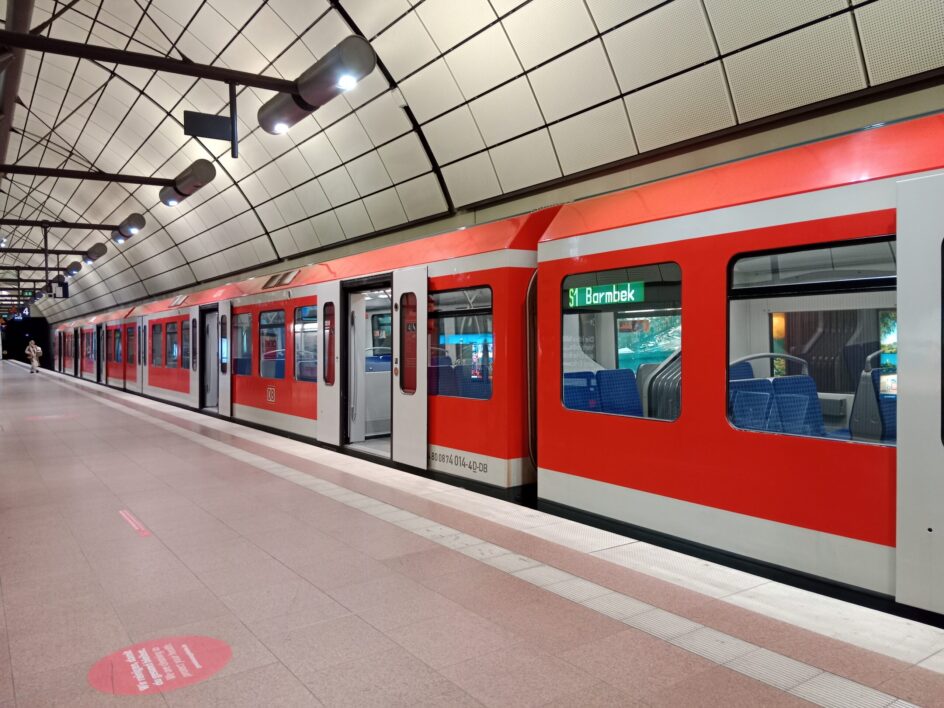
The S-Bahn is the train you see above ground and over bridges that runs within the boundaries of city, connecting the outer suburbs to the city center. This is one of the trains that people take for daily transportation purposes, going to work, school, doing errands, visiting friends, going to a venue, going shopping, etc. The S-Bahn is therefore a ‘buy a ticket and hop on hop off’ service. S-Bahn services run regularly, one every 5-10 minutes and are only available in cities or metro areas around the country. Tickets can be bought immediately before getting on the train at a machine at the station.

The S in S-bahn stands for Stadtbahn which literally means “city railway” (“Stadt” meaning ‘city’, ‘town’, or ‘urban’, but originally also Schnellbahn, or Stadtschnellbahn which means ‘fast city railway’). It does not mean “street” (or Straße in German), which is a common misconception. It makes sense that it means ‘city’ or ‘urban’, because it runs within the same city and in the urban areas, going into different suburbs. The S-Bahn is (usually) operated by different subsidiaries of Deutsche Bahn (which is the national railway system, with “Deutsche” meaning “German”) in each city, for example, “S-Bahn Hamburg” or “S-Bahn Berlin”.
The trains have plenty of seats and standing room on board. There may also be dedicated space for bicycles depending on the city. You may need to get a bike ticket for your bicycle (because it takes up space), and if it is too crowded already, staff might prioritise passengers, wheelchairs, and strollers.
These urban trains do not have toilets on board.
Sometimes, tickets can be checked by a ticket inspector on board. If you have a paper ticket, a hole is punched in it.
U-Bahn

The U-Bahn is the other main type of urban transport within a city. The U in U-Bahn does stand for Untergrundbahn, which means “underground railway”. The only functional difference between the S-Bahn and the U-Bahn is that the U-Bahn is underground. It is also a hop on hop off service. Tickets can be bought immediately before getting on the train at a machine at the station. The operational difference is that U-Bahns are operated by the city transport authority and have their own dedicated transport system and tracks, and only available in a few major cities around Germany that have this service (such as Berlin, Hamburg, Frankfurt etc), whereas S-Bahn can share railway tracks with regional trains. For example, Hamburg’s main central station has tracks for regional, ICE, and S-Bahn trains. There is also access to the U-Bahn, but via a different entrance that has its own tracks and system underground. Even if parts of an U-Bahn track is above ground, it remains as an U-Bahn service.
Again, these are urban trains so do not have toilets on board.
Regionalbahn
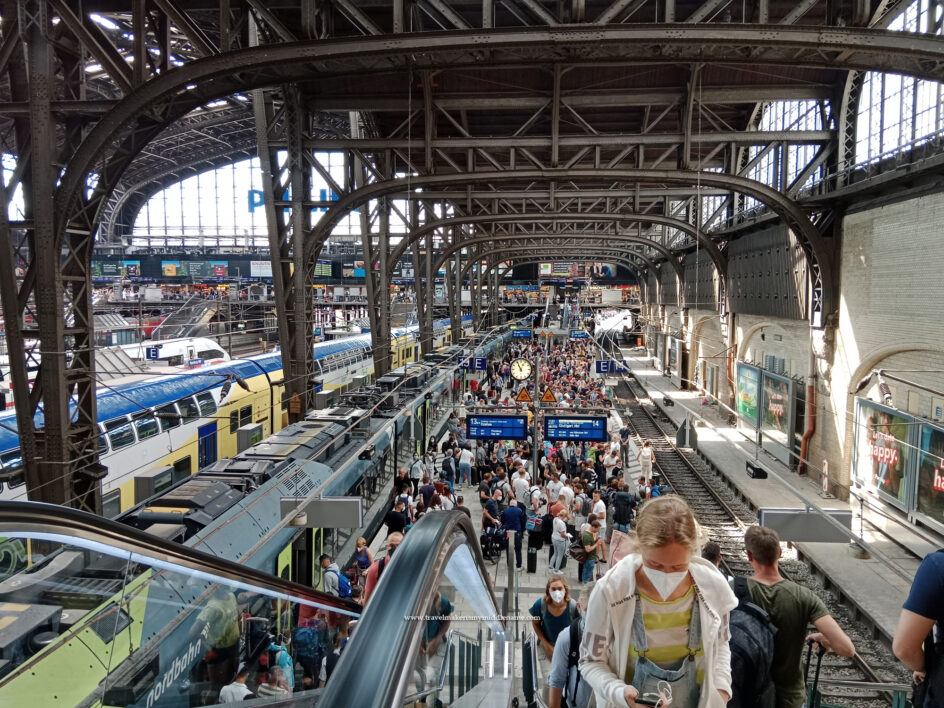
The Regionalbahn is the regional train that connects major cities with outlying regional or rural areas. This is a long distance train that travels at much faster speeds than the local S and U-Bahn trains, between smaller towns like Lübeck or Kiel, and connecting them to large cities like Hamburg.
The Regional trains run to a set schedule. Regional trains are marked with the letters RE in front of it, for example, RE7 or RE70.
No reservations are needed or offered. Regional trains have a variety of seating arrangements, for example, 4 to a small table with 2 seats facing forwards and two seats facing backwards. They come with a small garbage bin. There are also charging ports onboard, and a place to store luggage, and there are dedicated compartments for bicycles and large luggage.
Because Regional trains are long distance trains, there are toilets on board. These are basic toilets with a stainless steel toilet and very small wash basin. The toilets are equipped with soap, toilet paper, and paper towels but the stock level may vary especially in high demand times like during the now-ended 9€ ticket period.
When boarding a regional train, different compartments have a different boarding experience. Bicycle compartments have their entry level flush with the platform, so it is easy to get on with wheels and luggage. Inside a dedicated bicycle compartment, there is a lot of room for bicycles and luggage and a few seats. Other compartments may have a few steps going up, and there is not a lot of room at the entry level, you will have to take the stairs to the lower level or up to the top level for seating.
Tickets can be checked by a ticket inspector on board, if you have paper ticket, a hole is punched in it.
ICE InterCity Express trains

ICE trains are fast trains that connect cities. These may skip some small, regional towns in between. The physical train is a different vehicle to the Regional trains, ICE trains are white with red stripes running along the length of it. These trains are more modern and better equipped inside, with better seats, different classes (first and second, with first class being more comfortable and separated by a glass door), seat reservations, better toilets, and a dining car where you can get refreshments. A ticket inspector will definitely check your ticket.
Service:
ICE trains are long distance, including international trains that serve major city or regional central stations, and skip small regional train stations. Usually this means it is for trips planned at least somewhat in advance, so tickets might book out early in peak demand periods.
Reservations:
You do not need a reserved seat, but if you buy a train ticket without also reserving a seat (this costs extra), you might find that you have no where to sit on the train in peak demand period or routes – you are free to sit in an empty seat, but if someone has reserved that seat and boards later, they will ask you to move and you will need to move.
Restrictions:
There are different types of tickets for any given ICE service. Like plane tickets, cheaper tickets, like Sparpreis tickets, come with more travel restrictions, specifically, if you miss the service your ticket is for (for example, the 10am service from Berlin to Hamburg), you might not be allowed to use the same ticket for another service on the same route (for example, the 11am service from Berlin to Hamburg) since they are different services. Exceptions include when there is a delay caused by Deutsche Bahn leading you to miss your connecting train.
A note on train travel
Ticket checking:
Train stations in Germany don’t have ticket checking machines/gates/barriers. Instead, there are human ticket inspectors on the trains that come to check your ticket. This happens on any type of train, but most certainly the ICE trains.
Carriages:
All trains types have interconnected carriages, which means you can walk from one carriage to another, except where the carriage ends and joins the next carriage via a coupler.
Buttons on the door:
Long distance trains (the regional and ICE trains) have buttons on their door that you can press to open the door. The buttons are round, with triangles pointing outward. Trains arrive at a station several minutes before they are due to depart from that station, and the doors don’t stay open for the entire period. To get on, you may have to open the door yourself by pressing the button. Once you get on, the door might close again and stay closed even if the train is not leaving, not because the train is about to leave, but because the doors are designed to close when not in use.
Urban trains, like the S-Bahn and U-Bahn and even the Straßenbahn, as well as buses, have these buttons too, but usually they are redundant because the trains will open all functional doors at each station, and close only when the train is about to leave. There have been people who press the button from a middle or back door of a bus to get on though.
Available Services:
Each train service has a specific name, and each train service may run multiple times a day, and there may be more than one train running between any given two destinations, especially if they are major cities. For example, RE7 and RE70 are both trains that travel between Kiel and Hamburg, and run multiple times a day.
A note on international travel
ICE trains run internationally within Europe, so they are like the ground equivalent of air travel. This means:
- You may be asked for your passport/visa at border crossings while on the train.
- You may be wondering about luggage allowance: there are no restrictions on luggage weight, you just need to be able to carry them yourself.
Railway tracks
For clarification purposes: Trains in Germany are indicated by the track they are on (the German word for track being Gleis), and not platform, but it makes no difference if you follow the numbers.
Along a platform you will see the number of the platform (or track) and a capital letter – this is useful for finding the right carriage to board since not all carriages on all trains will go to the same destination.
Split platforms
The physical railway tracks at train stations in Germany can be shared by different trains going in different directions. This is called a split platform, and is shown by the platform number followed by lowercase letters “a” or “b”. For example, Kiel central station has 8 railway tracks and 7 platforms, 8 if you consider a split platform as 2. Trains can arrive at the station from opposite directions and leave in opposite directions on these open-ended tracks. Not all tracks are open ended. You have to be careful when boarding a train on a split platform to make sure you get on the right train on the right platform.
The picture below shows track (platform) 5 and 6, with track 6 being a split track, split into ‘a’ and ‘b’.

Split trains/carriages
Some trains, whether it is a regional train or an urban S-Bahn, are split trains, meaning at one point of the trip, the physical train will separate and each half go to a different destination. Sometimes a new carriage joins the leading carriage. This method gives maximum efficiency for trains passing a common area and only separating at a fork. You should be careful when getting on these trains so that you board the correct compartment, so that you don’t end up in the wrong place.
Station Facilities
Way-finding
All stations have clear signage and electronic information boards in German and English with information about trains and the platform they depart from. Always check these to make sure you board the right train.
Trains themselves also have an electronic information monitor on board.
Shops and eateries
Central train stations (Hauptbahnhof) will have shops and cafes or restaurants. These are independent shops and restaurants, and will vary at each station. Shops can include newsagents and souvenir shops, and food options can include dine in restaurants, cafes, fast food options, or takeaway places.
Toilets
Pay-per-use toilets are at each station. These usually accept coins only. Young children can enter with a parent for free.
Lockers
Central stations have lockers that you can hire with 1-2€ coins. The lockers are time dependent and come in various sizes for small bags or large luggage, and the price varies according to size and hire duration. The lockers are unmanned, self-serve, and accessible 24/7, same as the station All major cities have lockers in their train station, this is a fact cleverly utilised many times by Jason Bourne in the Bourne trilogy.
Boarding with wheels or have a disability?
There are dedicated bicycle compartments on trains indicated by a picture of a bicycle on the outside. these are usually the very front or very last carriage. Your bicycle might need to be stored vertically inside to fit.
Like bicycle carriages, there are dedicated wheelchair access carriages on trains. Germany is very big on accessibility and making everything accessible for everyone, so if you need help, just ask a staff member. Some carriages have steps going up into the train, to make boarding easier, you could board a bicycle or wheelchair compartment and move inside if necessary.
Straßenbahn
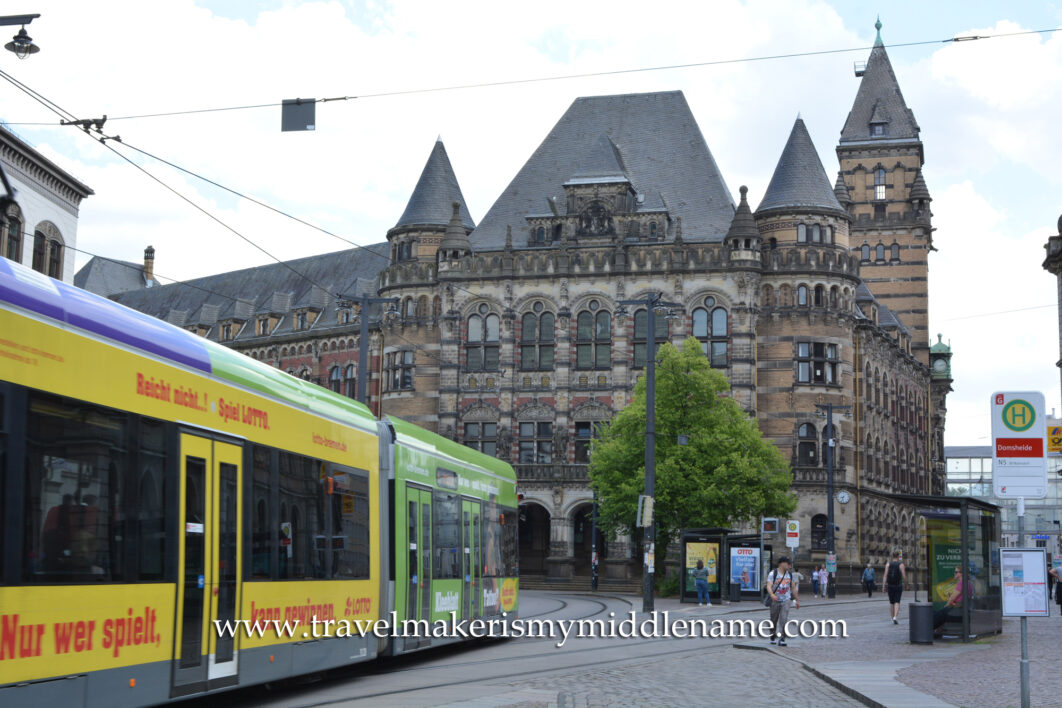
Straßenbahn literally means “street train”, ie street car or tram. The Straßenbahn is a tram that shares the road with cars and pedestrians on a dedicated track. It is a slower (compared to trains) transportation method that uses electricity for travel only within a city centre. Not all cities have this, some cities that do have it are Berlin and Bremen.
Tip: The Straßenbahn is pretty fun to ride in because it gives you a street level view of the city without frequently stopping, and, because of its size, it passes through open areas of the city and not small streets or built up areas with buildings the way buses do, so is a good, cheaper sightseeing alternative to sightseeing buses, and faster and more comfortable than walking.
List of helpful German words to navigate public transport in Germany
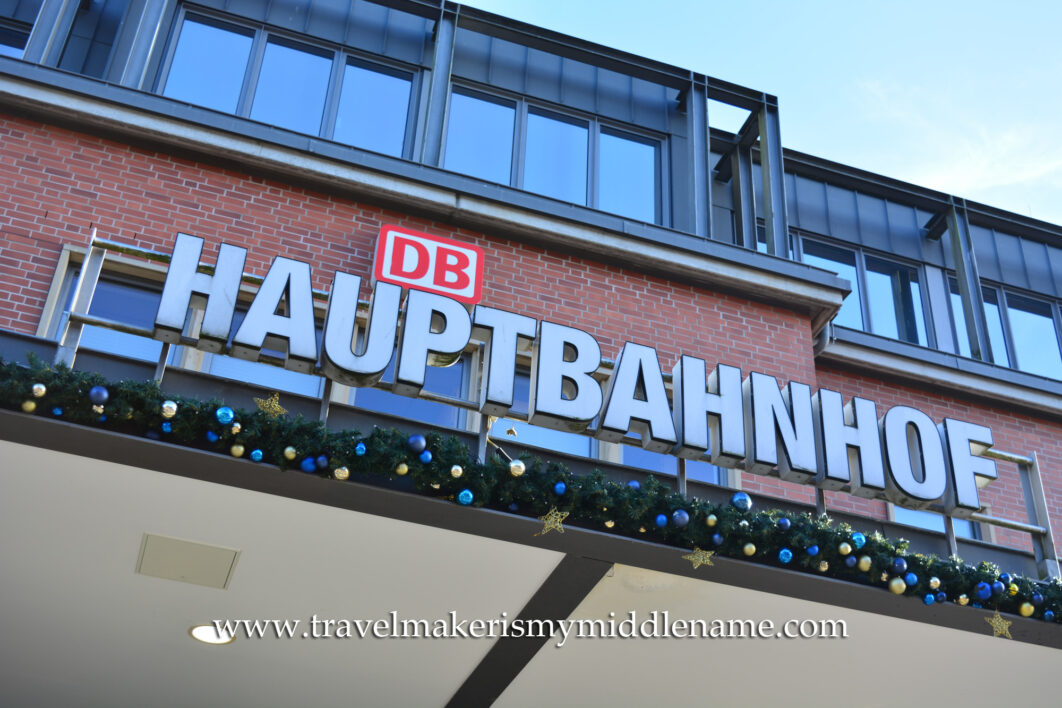
Most German public transport stations, whether bus or train, have service information written in English (like when the next service is and whether there are delays or cancellations), but not permanent signage, like platform numbers or the fact that a train station is a central station (Hauptbahnhof, see below). However, here are some words that would be helpful to know. If you are interested in learning some German before your trip, it would also be helpful to learn what the German alphabet and numbers sounds like so you can listen for announcements.
Ansage beachten = Observe or look out for announcements. Ansage = announcements, beachten = be aware, to observe. This means something has changed, whether a delay, cancellation, or change of platform.
Cancellations: There are more than one possible way of indicating a cancelled service. Ausfall is one of them, it means “cancellation”. German uses verbs with separable prefixes and conjugation to indicate tense or case. Zug fällt aus means the train (“Zug“) has been “cancelled” (fällt aus). A time could be inserted in this phrasing, such as “Zug fällt heute aus“, where heute means “today”; this means this specific train has been cancelled for the entire day, but it doesn’t tell you that there are replacement services, or whether other trains running between these two destinations are going or not. For example, the RE7 between Kiel and Hamburg could be cancelled for the day, but the RE70 might not.
Gleis = Track. This is usually written only in German. You will see that service indicators and platform indicators tell you the “Gleis” number (Gleis 5 is track 5); “Gleis” actually mean “track”, as in railway track, and not platform. It makes no functional difference, you can think of it as “platform”. The numbers are written in clear, Hindu-Arabic numerals, so it is easy to identify.
Hauptbahnhof: In German, “Hauptbahnhof” means “head train station” (haupt = head or main, bahnhof = train station), in other words, it is the “central station”. There may be more than one train station in a city, but there is only one central station.
Richtung = Direction, ie the direction of a destination. This word tells you in which direction the train or bus is going, but may or may not be the final destination. For example, it could go in the direction of B but the final destination is C.
Verspätung = Delay. Listen out or look for this word for indication of a delay in a service.
[email-subscribers-form id=”5″]
If you found this article helpful, please make a donation.
I know these messages are annoying, but please don’t skip this. If you’ve read this far, please make a donation. I am not just another blogger soliciting donations.
What I am asking donations for:
I need financial stability because my disabilities and chronic illnesses prevents me from getting a job to recover from a devastating financial loss. I am asking for donations to recover the money I lost.
Why I am asking:
I:
• have serious lifelong disabilities and chronic disease from multiple cancers, including a childhood one that destroyed my ability to grow and develop normally,
• live in a difficult situation,
• lost my life savings.
I am raising funds to rebuild the financial security I lost after becoming the victim of a scam. Due to severe disabilities and chronic illnesses caused by childhood cancer treatment and subsequent health problems, I am unable to work and cannot recover these losses through employment. Donations will help me cover essential living costs, medical expenses, legal costs, and to restore some semblance of living to my life and hopefully, pursue some dreams of mine.
Why now:
People rush to donate when a visible tragedy happens. The rest is ignored. Although my first cancer happened over 30 years ago when I was a small child, the consequences of the treatment is just as devastating, and even more so, since I was robbed of ever having a normal life from the beginning. My consequences are permanent and life-long. While it might not seem like a sudden event with great impact, the reality is, it is indeed an event with severe impacts. I live with the consequences of something I had no say in, every day, and it affects me minute to minute, in an increasingly severe manner, and I will always suffer the consequences, permanently. After years of trying to build financial independence despite my disabilities, I lost my savings through a scam out of desperation to try and leave an unsafe living situation. Because I cannot rely on paid employment, rebuilding those savings is not something I can possibly do alone.
How your donation can help:
The passage of time doesn’t make it better, in fact, it makes it worse. The long term effects of my cancer treatment gave me multiple permanent and degenerative disabilities and chronic medical conditions that requires ongoing health care and support. I have been long term unemployed as a result, and live in an unsupportive household with no other options. To make matters worse, out of desperation to get out of the hole I am in, I fell victim to a scam, losing my entire life savings and leaving me in complete ruin and further unable to change my situation. I am stuck in a vicious cycle because I cannot seek a better environment to move to without money, and I can’t earn money with all my health problems, and I can’t seek treatment interstate or overseas without money.
An authentic request:
I am remaining anonymous for safety reasons, but I have provided verification documents with identifying information redacted, in my fundraiser.
About this site:
Despite my disabilities and chronic health diseases, I love to travel. Most of the travel I have done and places I have visited, I went as a solo traveller. I started this as a blog in 2015, where I posted reviews and practical information about places I have been to. Now, this is a standalone site that contains practical and useful information that I gathered from first hand, personal experience and independent travel, and I pass on this information so you know what you’re doing and what to expect, instead of blindly following a tour group or an influencer’s cherry-picked and staged photos. All the food and destination photos on this website are taken by me. I maintain this site and and my other sites alone, and take great care to ensure content is correct at the time of writing, and practically useful for potential travellers.
If you connect with my story, find my content helpful, and want to support me personally:
Please donate to my personal fundraiser, or share my fundraiser if you cannot. I wouldn’t be asking if I had other options, and if everyone pitched in, my goal can be achieved. You can read about me on my About page. Thank you.
Alternatively, if you would like to support a female, solo and independent traveller, you can have a look at my photos here, prints are available for purchase: https://theintrepidphotographer.com/
©All rights reserved for all content and photographs, usage on 3rd party platforms, including, but not limited to, websites and smartphone apps, and to train AI in any way shape or form, is forbidden without prior written permission. Photos are taken by author unless otherwise stated and is available for licensing.
Related posts:
 Your practical guide to German Christmas markets: What to see, do, buy, and eat
 Cinque Terre, Italy: A practical guide for first-time visitors – where to stay, how to get there and what to expect
 Germany’s €9 Euro public transport ticket
 An introduction to Kiel, Germany for international students: Where it is, How to get there, and getting around
 Full breakdown of the Masters of Medical Life Sciences at the Christian Albrechts University of Kiel, Germany: Rules, Campus facilities, Semesterticket, Student card and more
 Your Guide to the Shanghai Metro – How to read signs and navigate the world’s busiest metro system